
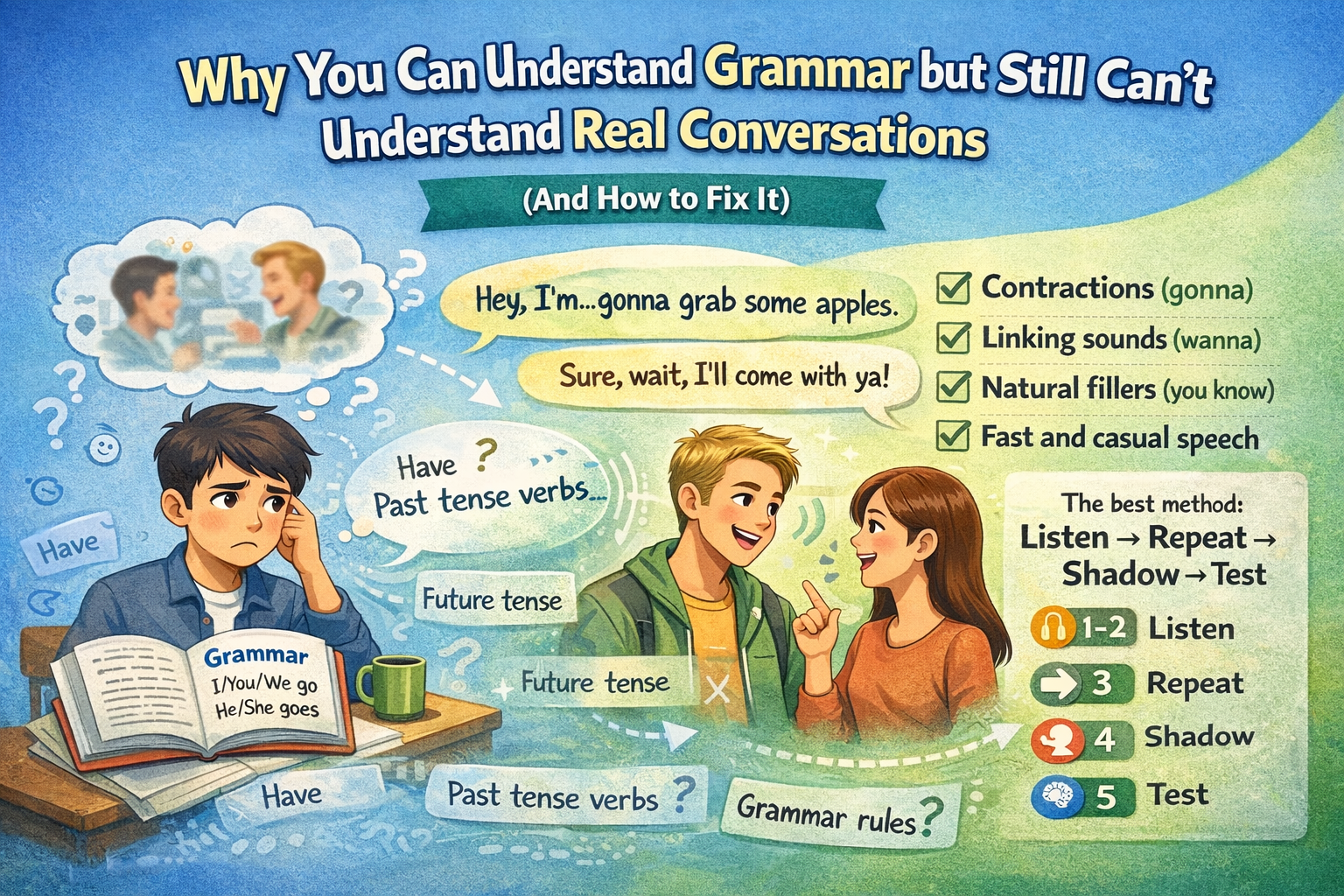
Do you feel like this?
You studied grammar for a long time. You know tenses. You can do exercises. You can read simple English.
But when you watch a real conversation, you can’t follow it. People speak too fast. Words sound different. You feel lost.
If this is you, it’s normal. And you are not alone. This pain point happens because real English is very different from textbook English.
1) Real conversations are not “perfect English”
In textbooks, sentences are clean and slow:
“I am going to the supermarket. I would like to buy some apples.”
But in real life, people speak faster and shorter:
“Hey, I’m gonna grab some apples.”
They also use:
-
contractions (I’m, don’t, can’t)
-
linking sounds (gonna, wanna, kinda)
-
unfinished sentences (“Yeah, sure… maybe later.”)
-
natural fillers (“um,” “you know,” “like”)
So even if you know grammar, your ears are not trained for real speech.
2) You learned rules, but not the sounds
Grammar helps you understand structure, but listening needs sound training. Many learners cannot catch words because:
-
speakers connect words together
-
pronunciation changes in fast speech
-
stress and intonation change meaning
Example:
“What do you want to do?”
Often becomes: “Whaddaya wanna do?”
This is not “bad English.” This is natural English.
3) You need short real-life dialogues (not long movies)
Movies are fun, but they are too long and too difficult for many learners. The best training is:
✅ short dialogues
✅ clear topic
✅ repetition
✅ step-by-step speed
That’s why Learning English At Home is a helpful place. We focus on real-life conversations with simple levels, so you can train your ears and your speaking together.
Here, you can practice:
✅ Slow listening + repeat practice
✅ Short dialogues for daily situations
✅ Common real-life phrases (not only grammar rules)
✅ “Your Turn” questions to answer out loud
✅ Speaking practice to build listening skills
When you practice in this way, you will start to understand real English naturally.
4) The best method: Listen → Repeat → Shadow → Test
Try this routine (15 minutes):
-
Listen once (no script)
-
Listen again with the script
-
Repeat each sentence 2 times
-
Shadow (speak at the same time as the audio)
-
Test: listen again without the script and summarize the meaning
Do this daily with short conversations. After 2–4 weeks, you will notice a clear change.
5) Don’t stop grammar — just change the focus
Grammar is still useful. But grammar should support speaking and listening, not replace them. Your main focus should be:
-
high-frequency phrases
-
daily conversation patterns
-
listening practice with repetition
-
speaking out loud every day
Start understanding real English today
Go to Learning English At Home and choose one short conversation lesson.
Then do this now:
📌 Comment: “I will train my ears with real conversations every day.”
And practice this sentence out loud 3 times:
“I can understand English step by step. I will not give up.”
